Archive
Defensible models and Historical Problem Spaces as an approach to assessing the validity of of historical games.
Disclaimer: I have advocated and used the criterion of what I call “defensible models” of the past for evaluating historical games for 16 years in print. Based on some recent interest in my network, I decided to write this VERY QUICKLY AND WITHOUT PROOFING and post this immediately on finishing it. It is a discussion piece, not even remotely a polished essay. I will revise and add in response to community feedback and get it into a more polished piece. Would love your feedback.
Improvement notes from first round of colleagues on BSky 3/25/26
- The jargon-free approach is helpful and educators and folks outside of game studies and HGS struggle all the time with this.
- But who am I arguing against – To Vinicius Marino Carvalho I suggested Deconstructionist history is one of the bigger lurking problems to practical educational approache
- Give some examples of games where there are “inaccuracies but defensibility to illustrate
- .The concision of “Some agents like this” is helpful. Maybe spell out the logic. What does a history game model? Historical problem spaces. So does it do that defensibly?
- Don’t negate or oppose discrete fact not-picking, “consume” say Nikhil ? And it’s a very good point. How could one critique model with no discrete facts?
- Address that the level of abstraction is a factor in all of this. At a high enough level of abstraction HPS becomes more defensible often.
We Should Move Beyond Evaluating a Historical Game Primarily on Whether it Portrays a List of “Facts” Historically Accurately
When I first started shifting from my independent work on video games and history education into the fledgling community of Historical Game Studies fostered by playthepast.org which was launched under founding editor Ethan Watrall’s guidance in 2010 I began as an educator and historian approaching games. I suggested in The Happiness Metric in CivCity:Rome and the Critique of Simulation Games (September 2010)
Read more…Asking whether a historical simulation game is accurate as if that were an all-or-nothing quality seems to me to be missing the point—the accuracy of any historical interpretation is not something that can be determined with any certainty. One historian’s common sense convention is another’s faulty construct to be dismantled. One generation’s conventions are the next’s biased assumptions. What really matters in historical interpretations is the extent to which any particular one is constructed based on the strongest, most defensible readings of evidence and the best supported and culturally sensitive understandings of human behavior. So, a far better criterion than accuracy when critiquing a historical simulation game is whether its core gameplay offers defensible explanations of historical causes and systems. So for example, it is not a question of whether a civilization building game allows a player to develop nuclear fission in the 17th century, but whether the game reasonably models the factors, including constraints, that lead to the development of such technologies. This focus on defensible models of causation is absolutely critical when one’s interests, like mine, center on using simulations as models to aid student (most often high school, but middle school and college as well) in understanding historical systems and learning to critique interpretations of the past. Let me be clear on the term interpretation here. We do not access the past directly nor do we present the past directly; we can only access and construct interpretations. This is true whether the interpretation comes from the Roman historian Livy, the modern historian McCall, or the game designers at Firefly. In this light, so long as a game’s core gameplay is historically defensible, any, even many inaccuracies serve as highly useful targets for getting students to launch evidence-based critiques. Evidence-based critiques is the operative term; simulation games should be critiqued using abundant references to the contents of valid sources of historical evidence.
Rough outline Dawn of Cities Prototype
For those of you following my posts on my Dawn of Cities prototype on LinkedIn or Blue Sky I plan to write this up along with a design document, but I wanted to sketch out the basic gameplay for those interested. Basically the idea is there are 6 players each playing as an elite household head. They have a starting set of hinterland farming villages, 1 village providing 1d6 (six-sided die). They have a record sheet to keep track of a series of non-farmer tokens (meeples)
Up to 2 elites (start with 1)
Up to 4 admin (start with 0)
Up to 4 labor (start with 0)
1 herder (a die that provides meat for feast and sacrifice)
4 farming villages.
A level 1 elite house, elite shrine (I split it from the house for game reasons), elite granary (I made this up based on staple-finance)
The goal of each elite player is to gain as much prestige as possible with the highest winning.

The farming villages are represented as colored poker chips in the player’s color on a big hex map board of a proto-city center and a hinterland surrounding:
Read more…Latest Rubrics for Long-Term Researched History Game Projects Available
I was going to hold off on these until the book comes out next year, but there has been enough recent interest on Bluesky (https://bsky.app/profile/gamingthepast.bsky.social/post/3lfkff3yow22a) that I decided to put my most recent rubrics up. Please share widely and credit me when you do so I can help more people get into powerful experiential and inquiry based learninging that is the researched history game topic.
These were designed for 9th and 10th grade history students in classes where students range from grade-level reading and writing to above grade level. To adapt for middle school, reduce requirements for sources (maybe give them a single source even), formal writing components, length etc. Also consider doing a lot of this in class (I often like to split my classes into 20 minute lecture 25 minute project work). If you are teaching in Uni, consider adding more peer-reviewed sources, increasing formal documentation and sophistication of project and decreasing class work time. Either way these rubrics work quite well at getting a product from students — with your expert guidance of course.
Happy to help you work with these any time (all my contacts are on my home page). And then … hopefully mid to late 2026, Designing Historical Games for the Classroom: A Practical Guide for Educators will be out with Routledge!
Cursus Honorum – History Game (for Class)
Just posted the most recent prototype (A1.8) for Cursus Honorum, a Roman Republic political competition game in the form of a Roll-N-Write. Needs a few player markers (4 per person is fine) and dice but other than that, print out the player sheets and go to it! I have playtested it with student groups of 4 and 5 and running multiple groups at the same time. I think it will work for 6; probably slows down too much with more than that in a single game. If you do check it out, I’d be grateful for any constructive feedback.

https://gamingthepast.net/wp-content/uploads/2024/01/cursus-honorum-protoype-current.pdf
Historical Game Design Theory and Practice: Dialogue with Luke Holmes, Part 2
Part 1 of our dialogue blog is here. Last time, Luke left us with Chris King’s argument that game developers should choose their historical interpretation based on whichever suits the gameplay best. I always felt a bit uncomfortable with that, but maybe I have too much of an agenda as a historian! . We’ll start this second instalment from there.
JEREMIAH: That does seem to be a rather bold statement. Here my response as an educator with historical games and as an academic studying historical games might differ. King’s suggestion works perfectly for a history class so long as the teacher presents the game as an interpretation, a model, that needs to be critiqued for defensibility by students (McCall 2011 and now McCall 2022, forthcoming). I suppose though that even from a more formal academic analysis, the idea of picking a historical interpretation based on mechanics is probably not noticeably different than the practice we mostly all seem to recognize: that in a conflict between fun/playability and historical accuracy (leaving aside how problematic that term can be), devs on record tend to say that they will usually go with fun/playability–I’d have to go back to look for references; pretty confident Sid Meier has said that. Also pretty confident that Soren Johnson agreed and elaborated on this principle back on my first GTP:Designer Talks podcast. In a sense “picking the historical interpretation to suit the game mechanics” is just a variation on this right? Even so, it’s a generalization of course, so whether devs pursue something more on the consistent with historical evidence (“defensible”) or less will depend on their originality pillar, right, to the extent that advancing a certain historical proposition could be part of a game’s originality? (or the expectations pillar if players expect a defensible historical model?)
LUKE: I wonder too if video games’ position in media-culture-hierarchy also gives game devs a lot of flexibility precisely because they don’t have to be defensible. Academics (and a lot of devs, too) would I think argue that video games very much are vehicles of history, but I’m not sure all audiences would agree. When video games aren’t presented as an authority (in the way that a book, museum, or academic might be, however flawed that is) the worry about whether a historical model fairly represents the period or discourse becomes unimportant – it is, after all “just a game”. For me though, games that take this line run a risk of trivializing the past, or even exploiting it for inspiration and genre appeal. It creates a nonsense proposition: that fun is directly incompatible with good history.
Read more…Prototype A Available – De Agricultura: The Universal Abstract Overly-Simplified Ancient Peasant Agriculture Game
Update for September: I did playtest prototype A with students and found the core game solid–at least enough for a good class reflection. Here is the most recent prototype that I used.
Like all prototypes, this will break, and I’d be grateful if you sent me a note about how it broke so I can improve on it. But I think Prototype A probably works well enough (I haven’t group playtested it — that’s where you all come in) to use in a class (I’m going to this August).
Prototype A PDF
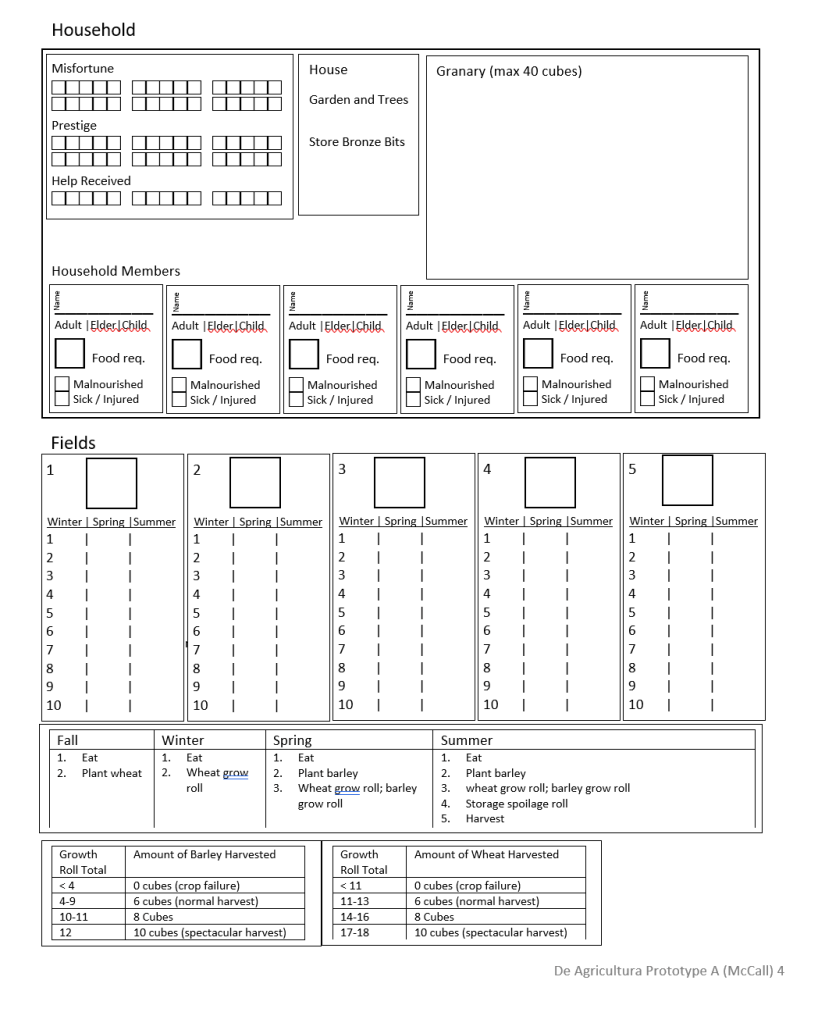
Briefly, the goals of the game are this.
A better appreciation/understanding of peasants in agrarian societies. It is very hard for moderns to appreciate that the vast majority of ancient agrarian societies (some 80-90% of population) were peasant farmers, i.e. subsistence farmers. They lived and worked in a state of subsistence, just enough to get by, with little bits of surplus food. That tiny surplus, magnified over thousands of peasants, was what the state extracted to fund non-farming activities from armies to building projects etc.
Read more…Dreams of Darkness as a Historical Problem Space: A Discussion
Friend and HGS colleague currently working with Dream of Darkness, Tamika Glouftsis, wrote an insightful blog in April Can the Historical Problem Space framework help us make better history games? I was excited to see her thoughts, not least of all because I’m considering a book project specifically on using the HPS framework to guide game design for students (in the form of interactive texts, and physical boardgame design) a guide that, hopefully, would have value for teacher-designers and historical game developers too. So with that in mind, and the pleasure of exploring this topic for any synergistic insights we or others might developed, I wrote some interlinear comments to Tamika’s post to continue the discussion, and Tamika wrote some additional comment to turn this into a dialogue. So what we have is, we think, an interesting discussion of ideas and a continued exploration of how developers (in addition to those studying historical games) might use the Historical Problem Space framework (McCall, 2020) as an analytical tool for historical game development. Both Tamika and I welcome further conversations on this, so please reach out to us with questions and comments
Read more…
GTP Designer Talks
Interviews with designers of historical video games. Posted here and on Spotify , Google Play, and Apple Podcasts.


 Gaming the Past