Archive
History and Game Links April – June 2019
Historical Video Games
- China: Mao’s Legacy, Steam blurb: “Year 1976, the stormy Cultural revolution has died down, hard times of hongweibing and public critics are coming to an end. Old and sick Mao Zedong will soon leave China to his comrades from CPC. The Cold War is coming into a new phase…
- Crusader Kings, Iron Century, The latest update (and free) for Paradox’s strategy/role-playing/diplomacy game set in the Medieval period. Iron Century starts players in the 10th century.
- Dawn of Man Steam blurb: “Command a settlement of ancient humans, guide them through the ages in their struggle for survival. Hunt, gather, craft tools, fight, research new techs and face the challenges the environment will throw at you.”
- Fort Sumter: The Secession Crisis. A well-received port of Mark Herman’s board game of the same name. Steam blurb: “Can you drive the Secessionist into the Fort Sumter trap that gave Lincoln his historic victory? Can you successfully use the issue of States Rights to divide Northern opinion? Fort Sumter let’s you explore this seminal moment in American history in a fast-playing, easy-to-learn card driven game.”
GTP Designer Talk 2 – Jon Shafer
Jon Shafer of Conifer games talks about history and historical game design in Civilization V and At the Gates
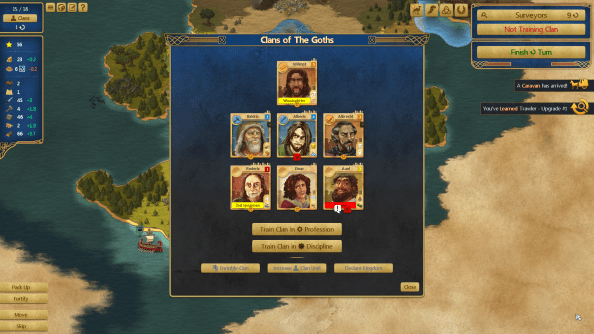
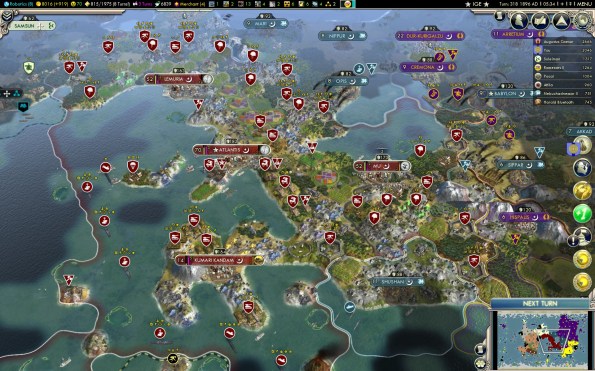
At the Gates is available at Conifer Games and on Steam
Civilization V is available on Steam
GTP Designer Talk Podcast #2: Jon Shafer of Civilization V and At the Gates
Recently, I had the opportunity to talk with Jon Shafer designer of Civilization V and through his Conifer Games, At the Gates , about a variety of topics related to history and historical game design. If opportunities continue for more of these GTP Designer Talks, I will get a Google Play, Apple Play, Spotify setup. For now you can follow the link to my Google Drive and download the mp3 on your player or listen to it here on the site.
Follow this link to my Google Drive for the mp3 file, to download it for listening on your phone/player
or listen right here here:
A Brief Intro Letter to US History Teachers
Taking a page from Emily Short and Chris Klimas’ blog playbooks, I was recently responding to a request from a teacher for suggestions using games for the first time in a college introductory-level US History survey courses\. I get requests like this every so often, and I’m delighted when new people find my work. I realized, though, I should probably post my suggestions on Gaming the Past for others to, hopefully, benefit from. So I polished it just a little bit, and here it is.
If you have more questions or want to dig deeper, I’m always willing to help out: jmc.hst@gmail.com
Hi
We. The Revolution
I should begin by noting that, despite its length, this is far from a complete review of all aspects of Polyslash’s French-Revolution-themed game, We. The Revolution. It is difficult to describe and review concisely as a historical game, and I have only played through the first act, the first 20 days, perhaps some 25 hours with restarts. New systems and mechanics continue to appear.
Not a criticism. Far from it. Ultimately, I am sincerely impressed with WTR. Opinions will vary about the enjoyability of the game (and I encourage readers to read a mainstream games media review when considering playing purely for enjoyment: Anthony Marzano at Destructoid and Robert Purchese at Eurogamer both offer good reviews): is it too linear? are some of the mechanics insufficiently clear and in need of more development? does the quality of voice acting detract too much from the game? What kind of game is it anyway?
Interview: Matthieu Brevet, Steel Division II
Recently, I had the opportunity to pose a list of questions about history and games to Matthieu Brevet, historian and game designer at Eugen Systems, makers of both historical and counterfactual strategy games such as R.U.S.E., the Wargame series, and Steel Division: Normandy 44. Eugen is finishing up production as lead designer of the WW2 real-time strategy game, Steel Division II. The game releases on Steam June 20, 2019, and is available for pre-purchase now.
Jeremiah McCall: Hi Matthieu. Thank you so much for your willingness to talk about your work as a designer of historical video games. There are a number of us who study and talk about historical games as kinds of history, and your insights as a professional designer are invaluable.
Can you, for readers’ sakes, tell us a little about yourself, the work you’ve done in game design, and your current project?
Matthieu: I’m 40 and I’ve been (very) briefly a high school History teacher while studying & obtaining a PhD in Napoleonic History. Since then, I’ve been combining my passion for History with my other one for strategy videogames by working at Eugen Systems. First as a game designer (RUSE, Wargame: European Escalation & AirLand Battle), associate producer (Wargame: Red Dragon, Act of Aggression & Steel Division: Normandy 44) and now lead game designer (Steel Division 2).

New History and Games Article on Journal of Geek Studies
A new survey article I wrote recently is now up on the Journal of Geek Studies
Playing with the past: history and video games (and why it might matter)
It essentially is a broad general survey of the topics and issues in historical games, history learning, and history education, I have been working on the past 14 years. I hope it will prove to serve as good introduction to a bit of the field (though my review essay in S&G 2016, is still a better bet for bibliography)
Gaming the Past Designer Talk #1 Civilization Game Designer Soren Johnson
Those studying historical games need to have more conversations with the designers and developers that actually make these games. I am exploring the possibility of doing some interviews to host on Gaming the Past for anyone interested in learning more about how historical game designers see their games and the role of history in the design process. Since I have used Civilization III and IV in my high school classrooms for the past decade or so, Soren Johnson, designer of those games and now CEO of Mohawk Games working on the historical game 10 Crowns, seemed a perfect first designer to interview. Soren kindly agreed to talk with me about his perspective on history and games as a designer. It was fascinating for me, and should be worthwhile to anyone interested in the development of historical video games.
Click this link to my Google Drive mp3 file, to download it for listening on your phone/player
or listen here:
History and Games Links – October 2018 to March 2019
Life has a way of rushing by; here we are, and there’s been no history and games links post since mid 2018. Needless to say; this is a long one.
Historical Video Games
- 11:11 Memories Retold Tagged as a Casual/Adventure game. Steam Blurb: “11th November 1916, a young photographer leaves Canada to join the western front in Europe. The same day, a German technician is told that his son is missing in action. Both want to preserve their humanity and come back alive to their loved ones.”
- Assassin’s Creed: Odyssey
- Holly Nielsen, The Guardian, Assassin’s Creed Odyssey review–an epic journey through ancient Greece 10/11/18
- Aron Garst, PCGamesN, “How historically accurate is Assassin’s Creed Odyssey? We asked a Classics professor.”
- Starting Point Episode 186: Odyssey and History (podcast)
- Jon Shafer’s At the Gates, Steam Blurb: “At the Gates is an indie strategy game from Jon Shafer, designer of Civilization 5. You are a dark age lord building a kingdom to replace the crumbling Roman Empire. Manage your clans, explore the landscape around you, harvest its resources, and build a mighty economic and military machine.”
- Dominic Tarason, Rock, Paper, Shotgun, “Jon Shafer’s At the Gates launches next month,” 12/11/18

GTP Designer Talks
Interviews with designers of historical video games. Posted here and on Spotify , Google Play, and Apple Podcasts.


 Gaming the Past