Gameworld Space and Action-Choices in Historical Games (HPS framework)
Just a quick reminder/introduction. The Historical Problem Space framework is a set of terms and concepts I’ve been developing over the past decade+ to help all intersections of educators and academics analyze historical video games in away that is holistic and recognizes that historical games are both functional as working computer programs (and, to a lesser but still useful extent, analog games) and as cohesive designs. This means any particular historical phenomenon in a game is functionally and cohesively connected to al the rest of the game design.

The framework continues to develop but my most recent core writings on this are:
The Historical Problem Space Framework: Games as a Historical Medium (2020)
Gaming the Past: Second Edition (2022)
And there are links to other articles and talks about HPS on this page
Greetings to all who, like me, find themselves fascinated by historical games,
Not infrequently I find my thoughts well ahead of my writing on the Historical Problem Space framework for historical game analysis (https://gamestudies.org/2003/articles/mccall) (Yes, I’m that sort of person who thinks about games and history games a significant amount of the time) Today I was working out a lecture on 4x games so that my students will have some genre understanding when looking at Colonization and Imperialism (the 4x games — but of course the historical phenomena too). I’ve been referring to the different kinds of action-choices a player agent can make in gameworld space.
I have listed and briefly discussed some of the core action choices a player agent has available in a gameworld space. I thought I had perhaps listed them all in the 2020 article, or perhaps in GTP 2.0 but now I’m thinking the core action-choices in gameworld space should be (helpfully, I hope) set out in one places until I can work them into a published article or book.
So, a quick reminder, the gameworld space is the space in which the player agent (the main playable character) pursues the goals (if they choose) that the developers have set for them and, while doing so, encounter the various elements in the space (a.r.t.o s = non-player agents, resources, tools, obstacles etc). The player agent makes and takes action choices in order to (if they choose) attempt to achieve the goals the developers have designed for the game. The “problem” in the historical problem space design that is standard in historical games, is to solve, avoid, overcome, utilize etc. the elements (a.r.t.o s) in the gameworld space that are keeping the player agent from the designed goals or can help the player agent.
Action-choices in historical video games are mostly (almost always) contextualized within the game. There are a few core action choices. I’ve found, however, that represent the main ways a player agent can act with the gameworld space itself. These are:
Exploring: which involves discovering things in the space that were not apparent to the player agent.
Traversing: moving the player agent (when an embodied player agent) or the player-agents’ agents (when an unembodied agent) from one point to another in the gameworld space
Since the goals of these terms, like those of the whole HPS framework, is to illuminate and analyze, not gatekeep, note that it’s a subjective call whether one is only exploring, only traversing, or both. They are not always simultaneous but they are often paired. Traversing to a different location that happens to be covered in a fog-of-war–common in war, 4X, and rts games–is two action choices in one: exploring and traversing. And traversing to a location whose state has changed even though it is revealed on the map, also seems to be both traversing and exploring.
In addition to exploring and traversing gameworld space, some games also include one or more of the following spatial action-choices:
Contesting: preventing or attempting to prevent non-player agents or rival player agents etc. from occupying a gameworld space. This happens all the time in historical strategy games: RTS games like Age of Empires, Company of Heroes, etc; 4Xs like Old World, Civilization, Humankind, Imperiums ; Total War games; Paradox’s grand strategy games, etc. With a little flexibility in applying the term, perhaps, arguably though, contesting takes place regularly in Third Person Adventure games like Assassin’s Creed and FPS like Call of Duty, Battlefield and Kingdom Come. Let’s take 3PAs for the moment. Dodging, blocking, and attacking in 3pa’s boil ultimately are actions allowing access to or contesting the space the agent occupies or is adjacent to. To stealth-move around an enemy agent, one is choosing not to contest the space the enemy agent occupies. Attacking an enemy agent requires colliding a harm-causer (fist, arrow, sword, bullet) with the target by entering the target’s space. I think that amounts to a contest. I’m certainly open to other interpretations. Thoughts?
Controlling: a little different from contesting, controlling is, well, being the designated “controller,” the occupier, the possessor of a space (so like imperialism games where a region is painted the player-agent’s color regardless of whether it has forces to defend it). Arguably a watchful guard who can see a location the player agent needs to get to, or the unit who has zone of control on nearby spaces also are controlling space.
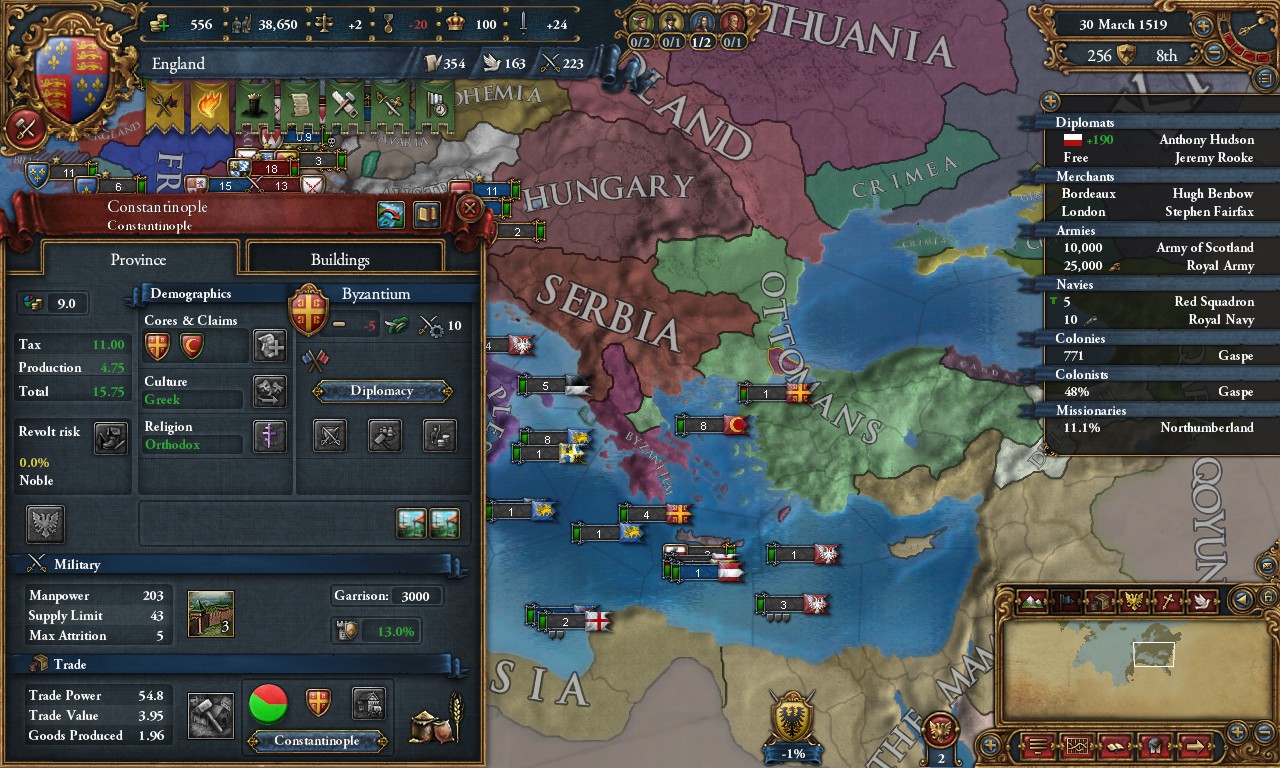
Like exploring and traversing, contesting and controlling are often closely related.
Then there is one more pair (others exist, I’m sure, but most fit into these 6)
Exploiting: extracting some advantage, usually a resource, from a space on the map. Exploiting is a standard action in RTS, 4X, Grand Strategy, and Hybrid strategy games. And let us not forget the mobile game genre, which might be described as the Time and Labor management genre (DomiNations, Rise of Culture’s etc. Exploiting is closely related to, but not always identifical to
Developing: adding something to a space (a building, a mine, whatever) that increases the value of the gameworld space for the player agent. This can be by constructing a tool like a building to produce units, or something that increases the resource extraction or revenue of a space, or its defensive capabilities, etc.
Developing and exploiting often go hand-in-hand
- A player agent generally develops a space so they can exploit it. Most often neither of those actions-choices are available if the player does not control the space,
- Successfully controlling the space generally requires successfully contesting the space
- And exploring and traversing are closely related. The distinction that s helpful, I think, is that exploring provides new knowledge while traversing is about movement without new gamespace knowledge. So, pretty close
Is this helpful? I find it pretty useful for the Historical Problem Space framework, since the goal of the framework is a set of terms and concepts that facilitate analyzing historical game holistically as systems of systems with a player agent.
As always, discussion, debate, and constructive objections always welcomed!
If you want to read more about the Historical Problem Space framework – here’s the current bibliography
Leave a reply to Angela Cancel reply

GTP Designer Talks
Interviews with designers of historical video games. Posted here and on Spotify , Google Play, and Apple Podcasts.


 Gaming the Past
An insightful dive into the intricacies of historical gaming! ‘Gameworld Space and Action-Choices in Historical Games (HPS framework)’ provides a nuanced perspective on game design and narrative choices within historical contexts. This article is a must-read for gamers and developers alike, offering valuable insights into the evolving landscape of interactive storytelling. A thought-provoking exploration of how gameworld space influences player choices, enhancing the overall gaming experience.
Thanks for saying so; I appreciate it!