The Historical Problem Space Framework for Game Analysis and Design
This page is the new repository for my writing and materials on the Historical Problem Space framework including downloadable versions of various note taking and analysis charts. HPS is a media-sensitive method for analyzing historical video games as games. It provides terminology and concepts for historical game analysis that focus on the cohesion and functionality of games as complete systems. But the HPS framework also provides an approach and guidance for how to design historical games by helping designers think about the core of their games: agents with goals making choices and taking actions (action-choices) in a gameworld full of elements that can help or hinder them.
Essays and Background
The most detailed presentation and application of Historical Problem Space terms and concepts for analysis:
McCall (2020), The Historical Problem Space Framework: Games as a Historical Medium; McCall (2022), Gaming the Past: Using Video Games to Teach Secondary History, Second Edition. Routledge;
and
For a shorter more generalist introduction, see the essay I wrote for Playthepast.org and Gamingthepast.net: McCall (2020), An Introduction to Historical Problem Spaces
For an entry on historical games that includes HPS and a brief critique of the biases of gamic history as historical problem spaces: https://eolt.org/articles/history-games
A Playthepast essay in two parts using HPS terminology and its emphasis on close-reading to analyze Paintbucket Games’ Through the Darkest of Times Through the Darkest of Times’ Historical Problem Space, Part 1 and Part II
My earliest work on thinking about games as historical problem spaces, the initial article on the topic is here: McCall (2012), Historical Simulations as Problem Space: Criticism and Classroom Use and McCall (2012), Navigating the Problem Space: The Medium of Simulation Games in the Teaching of History
Talks and Videos
“Agents and Obstacles: Videogames as Historical Problem Spaces” a talk for the University of Helsinki’s Games Research Collective 5/20/21
“Civilization IV and V as Gamic Histories” recorded for Dr. Constance Steinkuehler’s Games in Society Class at UC Irvine 4/10/20
Diagrams for Analyzing amd Designing Historical Games
These can be useful for analysis while designing historical games, academically dissecting historical games (whatever level of student/scholar)
Conceptual Diagrams
2026 Version – Includes a fairly comprehensive list of the types of action-choices most commonly associated with gameworld space and each of the A.R.T.M.O.s (gameworld elements: (non-player) agents, resource, tools, metrics, obstacles.)
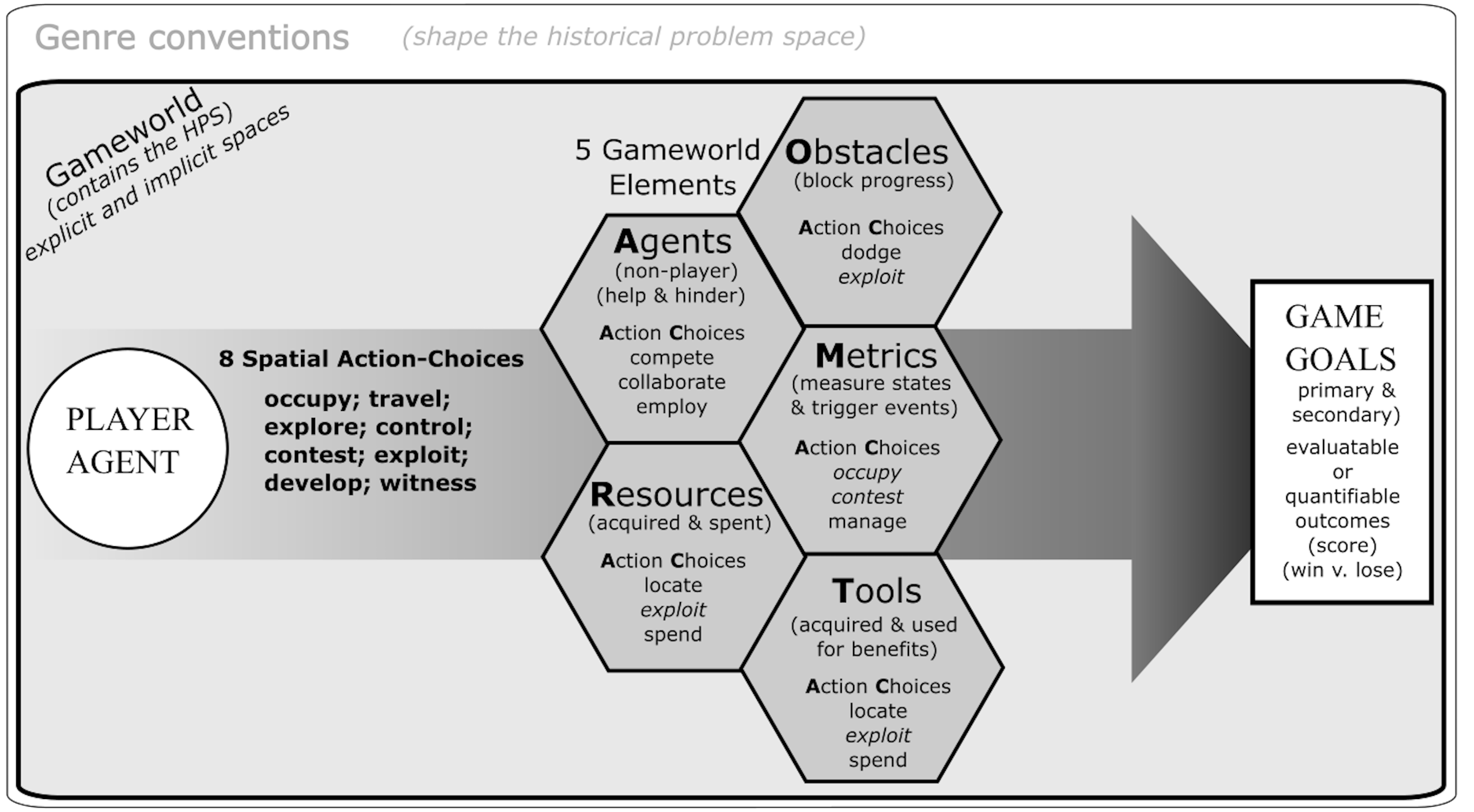
Pre-2026

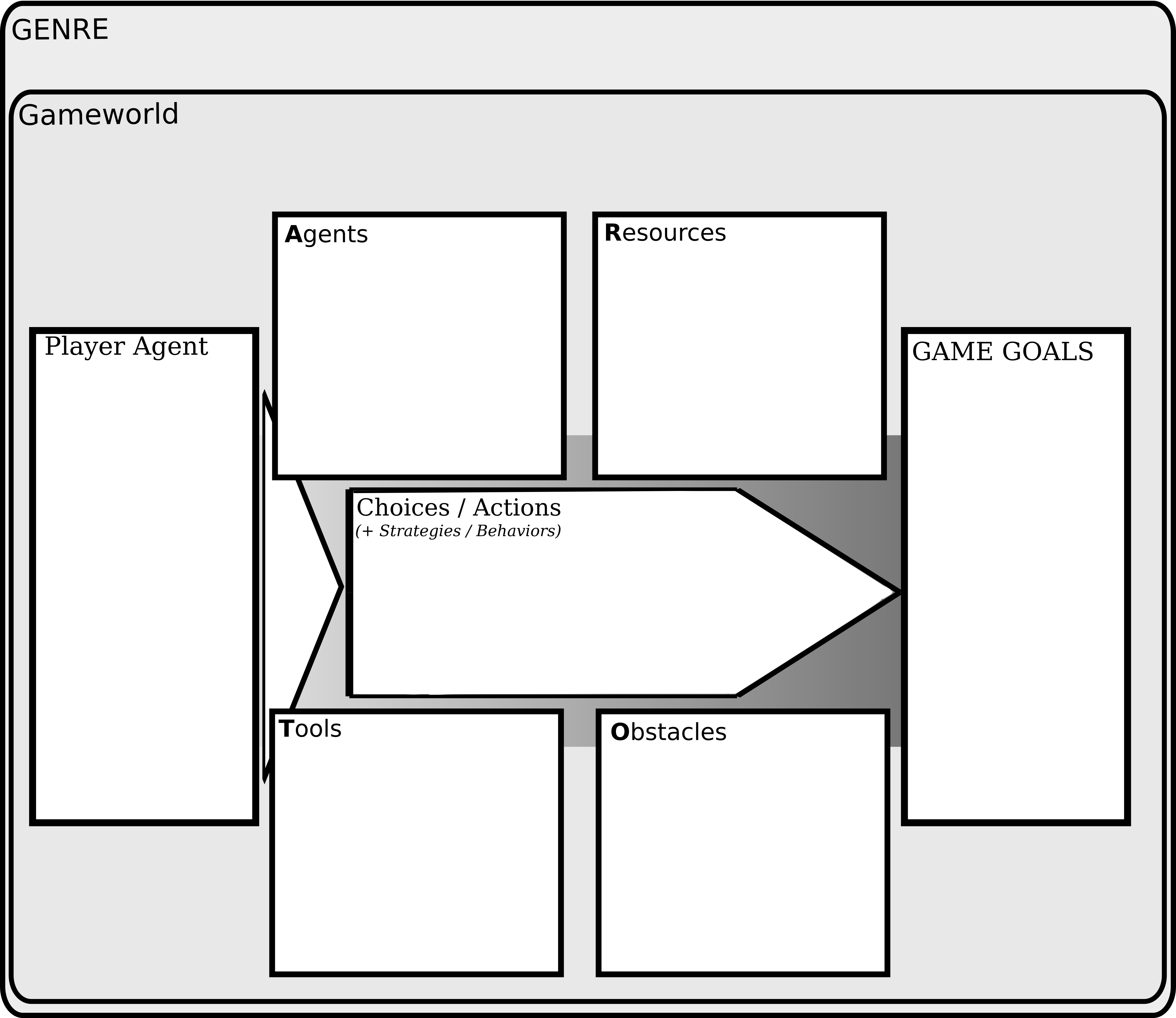
Diagram-Style Blank Note Sheet
Note Sheet Style 2 with Genre
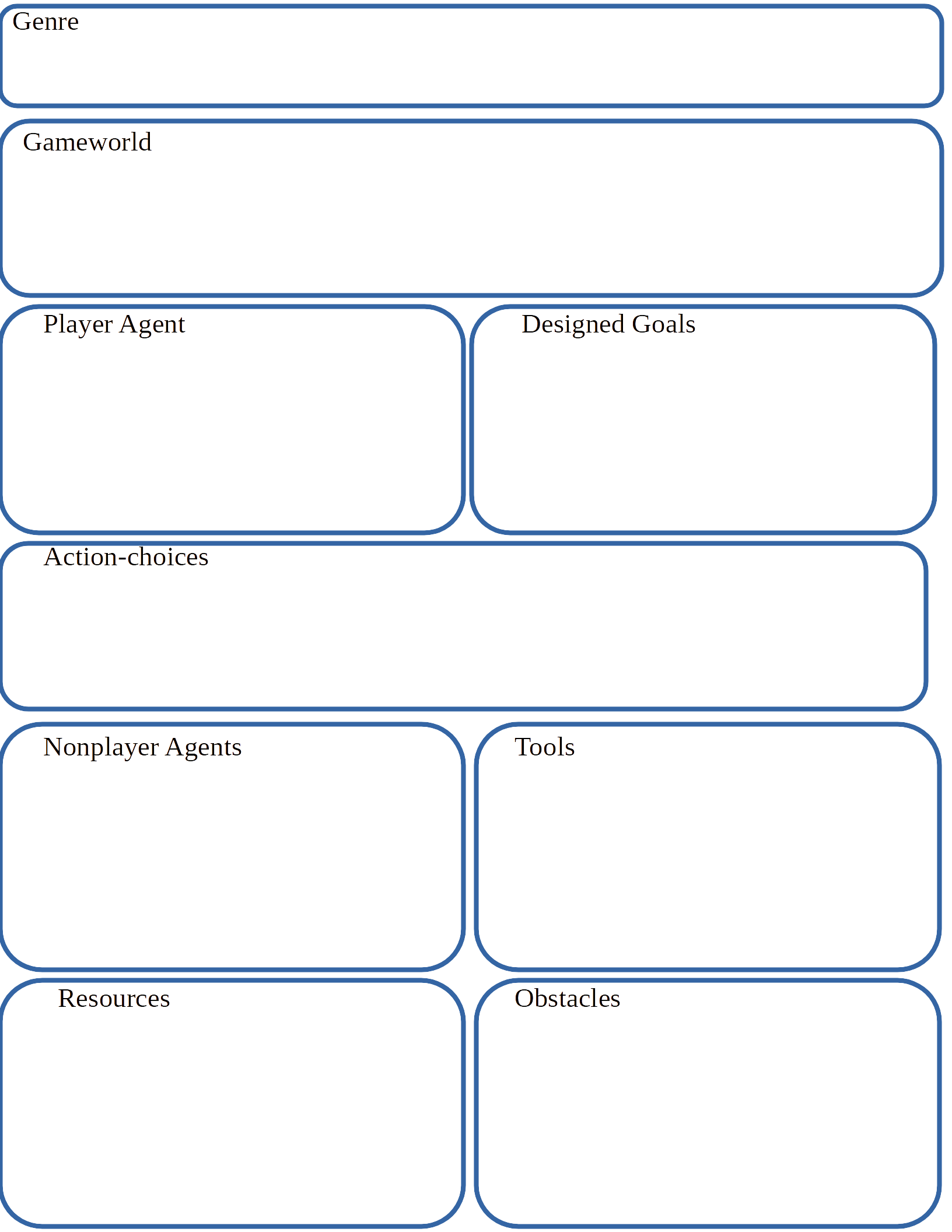
Note Sheet Style 2 without Genre (because sometimes you need the extra space during classroom analysis and or note-taking)

A (Developing) Glossary of Terms
To be filled in over time. Since the HPS framework continues to be developed over time, these terms are found in various places, all listed in Essays and Background above. Gaming the Past, Second Edition and my Game Studies essay of 2020 contain most of the terminology. A forthcoming article will discuss some terminology in more detail.
- action-choice: the actions that the player agent can choose to take as they pursue the designed goals. This includes forming strategies and adopting behaviors. Critical to meaningful action choices is often the trade-off between choices, what is gained or lost choosing x instead of y.
- allied agent: a non-player agent, or multi-player player agent who works with the primary player agent as they pursue their goals
- attenuated victory: designed goals in a game that bring the player agent victory but of a restrained or somber sort. For example, the goal in When Rivers Were Trails is to safely reach a new reservation, but in doing so, the player agent is technically victorious but still has been pushed off their land by the US and forced to resettle hundreds of miles away from their traditional home. Likewise, the goal in Through the Darkest of Times is to survive resisting the Nazis but the player agent cannot stop the Nazi rise or the Holocaust even if they win the game. Attenuated victories can be helpfully contrasted with triumphant victories.
- brand genre: those sets of shared attributes and features that tend to persist within a certain brand of games like Assassin’s Creed, Call of Duty, Civilization, Rockstar Games’ Red Dead Redemption and Grand Theft Auto, etc.
- cohesive, cohesion: the widely acknowledged principle of good game design that the parts of the game work together mechanically and thematically to form a whole. Sid Meier once expressed the standard of cohesion by referring to the “Covert-Action Rule.”-“one great game is better than two good ones”
- components (of the hps):
- contesting: one of the most common action-choices that agents can take in a gameworld space, competing or fighting to occupy a particular point in gameworld space.
- controlling: one of the most common action-choices that agents can take in a gameworld space, limiting access to or benefit from a particular point in gameworld space.
- defensible models: a practical standard of historical accuracy applied to a historical game that refers to the extent the models in a game are arguably consistent with available historical evidence. Suggesting that any particular historical game has defensible models acknowledges that all historyt is selective interpretation and subject to debate and revision. “Historical accuracy”, whatever that means, is not as useful a standard for discussing the historical models in a game as “defensible models”
- designed goal
- developing
- elements and systems of elements (in the gameworld)
- embodied agent
- explicit agent
- explicit space
- exploiting: one of the most common action-choices that agents can take in a gameworld space, gaining in game benefits from particular point in gameworld space, most commonly in the form of gameworld resources.
- functional: the fact that video games are made up of a series of rules and/or procedures that must mathematically precisely (notwithstanding inevitable bugs in code) interoperate.
- gameworld
- genre: the often quite recognizable features and attributes of mechanics and gameplay, interface, and developer practices that certain games share.
- goals
- historical archetype agents: An agent who represents a type or kind of person, commonly a profession like WWI nurses or Roman gladiators, attested n the evidence, but not a precise, named individual.
- historical archetype gameworlds: A gameworld that refers to a generic location in the historical world, often identified simply by common terrain features, not a specific documentable location.
- historically specific agent: An agent who can be specifically identified by name in the historical evidence, i.e. the agent existed in the past.
- historically specific gameworlds: Gameworlds that refer to a specific documented space and place in the historical evidence.
- implicit agent
- implicit space
- metric
- minion
- non-player agent
- obstacle
- opposing agents
- player agent
- player agent abilities
- scope of player agent abilities
- player agent attributes
- primary goal
- producer
- resource
- secondary goals
- subordinate agent
- tool
- traversing
- triad of agency: player-agent, goals, action-choices
- triumphant goals
- unembodied agent
- witness

GTP Designer Talks
Interviews with designers of historical video games. Posted here and on Spotify , Google Play, and Apple Podcasts.


 Gaming the Past